

Subscribe to RSS
DOI: 10.1055/s-0040-1718141
CIN2+ diagnoses between 2013 and 2018 in women 18 to 45 years old – Results from a German statutory health insurance claims data analysis
Authors


Objectives Cervical intraepithelial neoplasia (CIN) can result from Human Papillomavirus (HPV) infection, can present considerable burden to patients (surgical procedures/psychosocial consequences) and may be prevented by HPV vaccination. The objective was to estimate the 2013-2018 annual proportion of women 18-45 years-old with CIN2+ diagnoses in Germany.
Methods We conducted a retrospective cross-sectional claims data analysis using the Institute for Applied Health Research Berlin (InGef) Database, representative of the German population regarding age and gender. The annual proportion (2013-2018) of 18-45 year-olds with CIN2+ diagnoses was calculated as number of women with at least one respective ICD-10-GM record divided by the total number of women in the database.
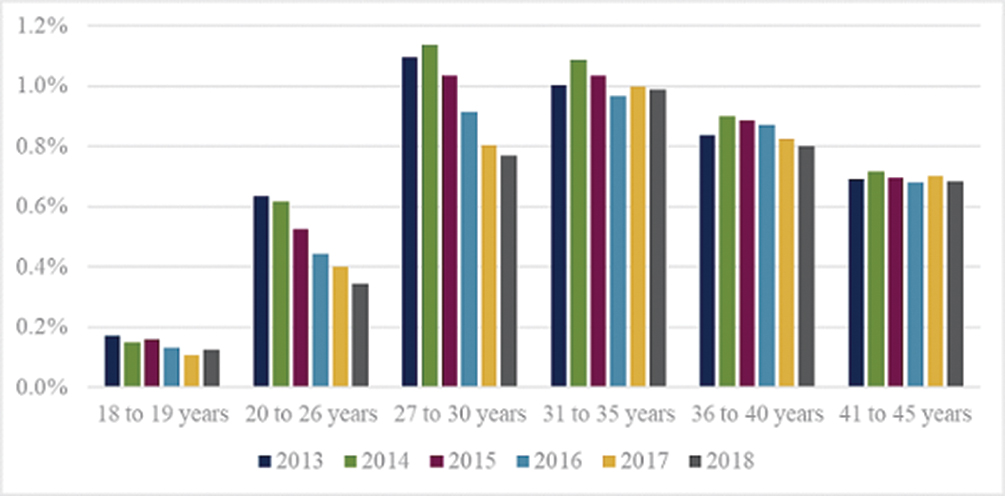
Results The overall proportion of women 18-45 years-old with CIN2+ diagnoses was 7.9/1,000, 8.2/1,000, 7.7/1,000, 7.2/1,000, 7.0/1,000, and 6.7/1,000 in 2013, 2014, 2015, 2016, 2017, and 2018, respectively. Women 31-35 years-old accounted for 23.2 % and 28.3 % of CIN2+ diagnoses in 2013 and 2018, respectively. The proportion of 20-26-year-old women with CIN2+ diagnoses was 6.3/1,000 and 3.4/1,000 in 2013 and 2018, respectively (Figure 1).
Conclusions The burden of CIN2+ diagnosis in women >30 years remains substantial. Changes in CIN2+ diagnoses 2013-2018 could be driven by changes in HPV vaccination, behavior, and screening patterns.
Interessenkonflikt
This study was funded by MSD Sharp & Dohme GmbH. Anna-Janina Stephan, Miriam Reuschenbach, and Regine Wölle are full time employees of MSD Sharp & Dohme GmbH. Vimalanand S. Prabhu is a full-time employee and Sushama Tanniru is a full-time contractor of Merck Sharp & Dohme Corp., a subsidiary of Merck & Co., Inc., Kenilworth, NJ, USA. Kim Maren Schneider, Alice Schneider, and Christian Jacob are full-time employees of Xcenda GmbH, acting as contractors of MSD Sharp & Dohme GmbH for the execution of this study. Wolfgang Greiner declares no conflict of interest. Monika Hampl received honoraria as speaker and member of medical advisory boards from MSD Sharp & Dohme GmbH.
Publication History
Article published online:
07 October 2020
© 2020. Thieme. All rights reserved.
Rüdigerstraße 14, 70469 Stuttgart, Germany