


Subscribe to RSS
 Download PDF

DOI: 10.1055/a-2744-2506
Electric-Field-Assisted Organic Synthesis: A New Frontier in Reactivity Control
Authors
H.C. and G.C. thank the School of Chemistry, Cardiff University for support. J.W. thanks the Institute for Basic Science in Korea for financial support (IBS-R10-A1). J.W. also acknowledges financial support through a KAIST (Korea Advanced Institute of Science and Technology) scholarship. R.L.M. would like to thank the Leverhulme Trust for a Philip Leverhulme Prize (PLP-2022-106).

Abstract
The application of oriented external electric fields (OEEFs) to modulate chemical reactivity—termed electric field catalysis—is emerging as a powerful strategy in synthetic chemistry. Inspired by nature’s use of internal fields in enzymatic systems, this approach offers the potential to control reaction pathways, improve selectivity, and reduce energy input. While the theoretical foundations are robust, practical implementation remains challenging, particularly due to difficulties in generating stable, precisely oriented fields at the molecular scale. Recent advances, however, are addressing these obstacles. Notably, the use of multiwalled carbon nanotubes (MWCNTs), owing to their nanoscale architecture, electrical conductivity, and chemical robustness, has enabled the creation of electromicrofluidic devices capable of delivering localised electric fields with high spatial precision. Collaborative efforts, including those by the Matile group and our own, demonstrate the viability of these platforms in catalysis. These developments mark a significant step toward the broader adoption of electric-field-assisted synthesis in organic chemistry.
Key words
catalysis - electromicrofluidic devices - molecular transformations - multiwalled carbon nanotubes - oriented electric fieldsBiosketches

Huw Chadwick studied chemistry at Cardiff University and earned his BSc in 2021. He then went on to achieve his master’s degree in medicinal chemistry in 2023 from Cardiff University after working with Dr. Louis Luk developing site-specific protein-labelling techniques. In late 2023 he joined Prof. Thomas Wirth’s group at Cardiff University, where his doctoral research focuses on the modification of electrodes for tuneable catalysis.

Georgia Cocking studied chemistry at Cardiff University and received her MChem degree in 2025 for her project on modifying the surface of carbon felt electrodes for electrochemical reactions. She is currently studying for her PhD in the group of Prof. Thomas Wirth, focusing on the development of alternative synthetic, sustainable methodologies.

Johannes Westphäling studied chemistry at the RWTH Aachen University in Aachen, Germany, where he completed his MSc degree in early 2024. During this time, he conducted short research stays at the Institute of Chemical Research of Catalonia (ICIQ) in Tarragona, Spain, and the Korea Advanced Institute of Science and Technology (KAIST)/Institute for Basic Science, Center for Catalytic Hydrocarbon Functionalisations (IBS-CCHF) in Daejeon, South Korea. He joined the group of Prof. Mu-Hyun Baik at KAIST/IBS-CCHF for his PhD studies, where his current research is focusing on computational chemistry and electro-inductive effects.

Rebecca Melen studied for her undergraduate and PhD degrees at the University of Cambridge, completing her PhD in 2012 with Prof. Dominic Wright. Following postdoctoral studies with Prof. Douglas Stephan in Toronto and with Prof. Lutz Gade in Heidelberg, she took up a position at Cardiff University in 2014, where she is now a professor in inorganic chemistry. Her research interests lie in main group chemistry and the applications of main group Lewis acids in synthesis and catalysis.

Thomas Wirth is professor of organic chemistry at Cardiff University. He received his PhD in 1992 after studying chemistry at Bonn and the Technical University of Berlin. After a postdoctoral stay at Kyoto University as a JSPS fellow, he worked independently at the University of Basel before taking up his current position at Cardiff University in 2000. His main interests of research concern stereoselective electrophilic reactions, oxidative transformations with hypervalent iodine reagents and flow chemistry performed in microreactors.
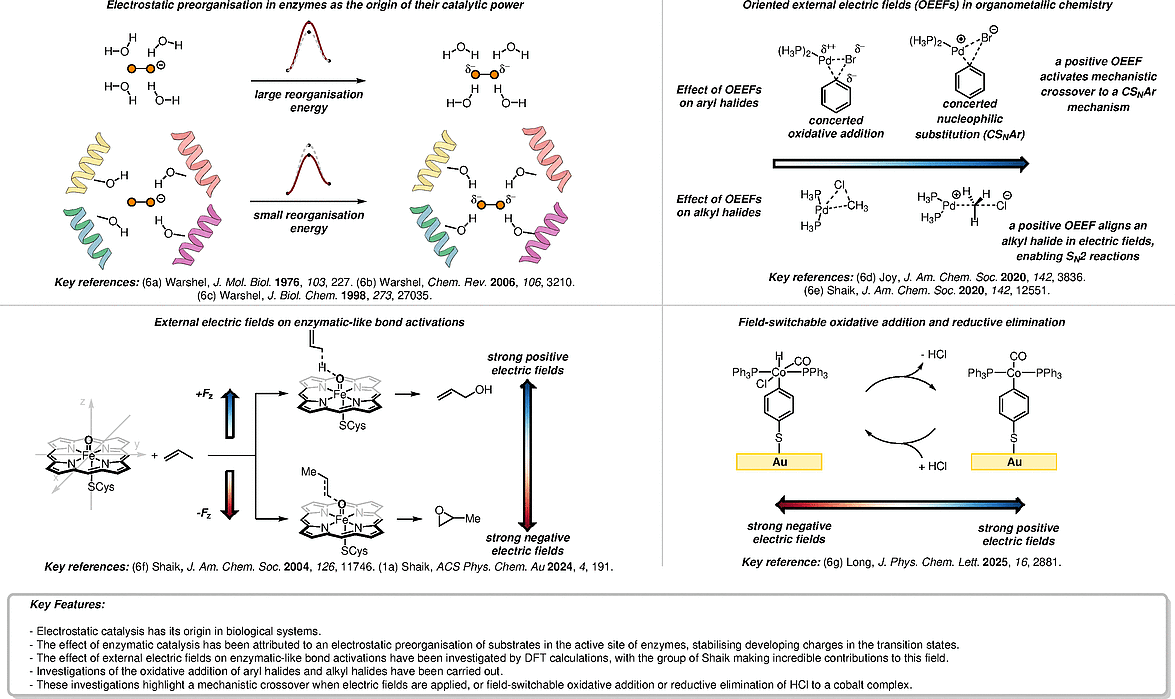
The emerging concept of using oriented external electric fields (OEEFs) to accelerate and steer the movement of electrons during chemical reactions is rapidly gaining traction as a transformative tool in synthetic chemistry. This approach, also referred to as electric field catalysis, is grounded in strong theoretical foundations[1] and is inspired by nature’s own use of electric fields in enzymatic catalysis.[2] The ability to modulate reaction pathways and enhance selectivity or efficiency by applying electric fields promises to redefine how chemists design and build molecules, potentially reducing energy demands and enabling unprecedented control over molecular transformations.
Despite its compelling potential, the practical implementation of electric field catalysis has remained elusive. Mainly technical challenges, for example delivering stable and precisely oriented fields at the molecular scale, and integrating such control into routine synthetic workflows, have slowed development in this area. Nevertheless, several pioneering studies have laid important groundwork, demonstrating proof-of-concept systems and innovative strategies for field-induced catalysis.[3] These early efforts have provided critical insights, though widespread adoption has been hindered by limitations in materials, device architecture, and field stability under the applied reaction conditions.
Control over the charge translocation during molecular transformations with oriented external electric fields appears highly attractive for organic synthesis. Recently, several research groups have identified a promising path forward by leveraging the unique properties of multiwalled carbon nanotubes (MWCNTs),[4] which offer high electrical conductivity, nanoscale dimensions, and chemical stability. The group of Matile (Geneva) and our own have integrated such MWCNTs into electromicrofluidic devices;[5] these structures present a viable platform for generating and controlling localised electric fields with the precision required for catalysis. This realisation opens new avenues for addressing longstanding barriers and brings the prospect of routine electric-field-assisted synthesis closer to reality.
Herein we show most of the recent developments in carrying out chemical reactions in electric fields and the current developments of using electric fields for reaction control.


Conflict of Interest
The authors declare no conflict of interest.
-
References
- 1a Shaik S. ACS Phys. Chem. Au 2024; 4: 191
- 1b Bofill JM, Severi M, Quapp W, Ribas Ariño J, de P R Moreira I, Albareda G. Chem. Eur. J. 2024; 30: e202400173
- 1c Kareem S, Vali SR, Reddy BV. S. Eur. J. Org. Chem. 2023; 26: e202300103
- 1d Van Lommel R, Verschueren RH, De Borggraeve WM, De Vleeschouwer F, Stuyver T. Org. Lett. 2022; 24: 1
- 1e Ciampi S, Darwish N, Aitken HM, Díez-Pérez I, Coote ML. Chem. Soc. Rev. 2018; 47: 5146
- 2a Siddiqui SA, Stuyver T, Shaik S, Dubey KD. JACS Au 2023; 3: 3259
- 2b Ji Z, Boxer SG. J. Am. Chem. Soc. 2022; 144: 22289
- 2c Welborn VV, Head-Gordon T. Chem. Rev. 2019; 119: 6613
- 3a Westendorff KS, Hülsey MJ, Wesley TS, Román-Leshkov Y, Surendranath Y. Science 2024; 383: 757
- 3b Li J, Xia Y, Song X, Chen B, Zare RN. Proc. Natl. Acad. Sci. 2024; 121: e2318408121
- 3c Sevim S, Sanchis-Gual R, Franco C, Aragonès AC, Darwish N, Kim D, Picca RA, Nelson BJ, Ruiz E, Pané S, Díez-Pérez I, Puigmartí-Luis J. Nat. Commun. 2024; 15: 790
- 3d Gong M, Wu Q, Kim JK, Huang M, Li Y, Wu Y, Kim JS. Sci. China Chem. 2024; 67: 1263
- 3e Zhu C, Pham LN, Yuan X, Ouyang H, Coote ML, Zhang X. J. Am. Chem. Soc. 2023; 45: 21207
- 3f Zhang B, Schaack C, Prindle CR, Vo EA, Aziz M, Steigerwald ML, Berkelbach TC, Nuckolls C, Venkataraman L. Chem. Sci. 2023; 14: 1769
- 3g Song Z, Liang C, Gong K, Zhao S, Yuan X, Zhang X, Xie J. J. Am. Chem. Soc. 2023; 145: 26003
- 4a Bornhof A.-B, Vázquez-Nakagawa M, Rodríguez-Pérez L, Herranz M. Á, Sakai N, Martín N, Matile S, López-Andarias J. Angew. Chem. Int. Ed. 2019; 58: 16097
- 4b Campisciano V, Gruttadauria M, Giacalone F. ChemCatChem 2019; 11: 90
- 4c Blanco M, Nieto-Ortega B, de Juan A, Vera-Hidalgo M, López-Moreno A, Casado S, González LR, Sawada H, González-Calbet JM, Pérez EM. Nat. Commun. 2018; 9: 2671
- 4d Tasis D, Tagmatarchis N, Bianco A, Prato M. Chem. Rev. 2006; 106: 1105
- 5 Gutiérrez López M. Á, Ali R, Tan M.-L, Sakai N, Wirth T, Matile S. Sci. Adv. 2023; 9: eadj5502
- 6a Warshel A, Levitt M. J. Mol. Biol. 1976; 103: 227
- 6b Warshel A, Sharma PK, Kato M, Xiang Y, Liu H, Olsson MH. M. Chem. Rev. 2006; 106: 3210
- 6c Warshel A. J. Biol. Chem. 1998; 273: 27035
- 6d Joy J, Stuyver T, Shaik S. J. Am. Chem. Soc. 2020; 142: 3836
- 6e Shaik S, Danovich D, Joy J, Wang Z, Stuyver T. J. Am. Chem. Soc. 2020; 142: 12551
- 6f Shaik S, de Visser SP, Kumar D. J. Am. Chem. Soc. 2004; 126: 11746
- 6g Long Z, Kelly HR, Videla PE, Menzel JP, Lian T, Kubiak CP, Batista VS. J. Phys. Chem. Lett. 2025; 16: 2881
- 7a Shaik S, Ramanan R, Danovich D, Mandal D. Chem. Soc. Rev. 2018; 47: 5125
- 7b Shaik S, Mandal D, Ramanan R. Nat. Chem. 2016; 8: 1091
- 7c Grimme S, Kruse H, Goerigk L, Erker G. Angew. Chem. Int. Ed. 2010; 49: 1402
- 7d Meir R, Chen H, Lai W, Shaik S. ChemPhysChem 2010; 11: 301
- 8a Aragonès AC, Haworth NL, Darwish N, Ciampi S, Bloomfield NJ, Wallace GG, Diez-Perez I, Coote ML. Nature 2016; 531: 88
- 8b Stone IB, Starr RL, Hoffmann N, Wang X, Evans AM, Nuckolls C, Lambert TH, Steigerwald ML, Berkelbach TC, Roy X, Venkataraman L. Chem. Sci. 2022; 13: 10798
- 8c Huang X, Tang C, Li J, Chen L.-C, Zheng J, Zhang P, Le J, Li R, Li X, Liu J, Yang Y, Shi J, Chen Z, Bai M, Zhang H.-L, Xia H, Cheng J, Tian Z.-Q, Hong W. Sci. Adv. 2019; 5: 6
- 8d Borca B, Michnowicz T, Pétuya R, Pristl M, Schendel V, Pentegov I, Kraft U, Klauk H, Wahl P, Gutzler R, Arnau A, Schlickum U, Kern K. ACS Nano 2017; 11: 4703
- 8e Zang Y, Zou Q, Fu T, Ng F, Fowler B, Yang J, Li H, Steigerwald ML, Nuckolls C, Venkataraman L. Nat. Commun. 2019; 10: 4482
- 8f Tang C, Stuyver T, Lu T, Liu J, Ye Y, Gao T, Lin L, Zheng J, Liu W, Shi J, Shaik S, Xia H, Hong W. Nat. Commun. 2023; 14: 3657
- 8g Alemani M, Peters MV, Hecht S, Rieder KH, Moresco F, Grill L. J. Am. Chem. Soc. 2006; 128: 14446
- 8h Sreelakshmi PA, Mahashaya R, Leitherer S, Rashid U, Hamill JM, Nair M, Rajamalli P, Kaliginedi V. J. Am. Chem. Soc. 2024; 146: 35242
- 8i Dief EM, Low PJ, Díez-Pérez I, Darwish N. Nat. Res. 2023; 56: 600
- 8j Chen H, Jia C, Zhu X, Yang C, Guo X, Stoddart JF. Nat. Res. 2023; 8: 165
- 9a Wang Y, Zhang J, Zhang W, Yao J, Liu J, He H, Gu C, Gao G, Jin X. Angew. Chem. Int. Ed. 2024; 63: e202402440
- 9b Gorin CF, Beh ES, Kanan MW. J. Am. Chem. Soc. 2012; 134: 186
- 9c Gorin CF, Beh ES, Bui QM, Dick GR, Kanan MW. J. Am. Chem. Soc. 2013; 135: 11257
- 9d Li X, Nong X, Zhu C, Gao X, Chen H, Yuan X, Xing D, Liu L, Liang C, Zang D, Zhang X. J. Am. Chem. Soc. 2024; 146: 29267
- 9e Gu Y, Xia Q, Liu B, Zhao Y, Pu L, Ding J, Liu Y, Li E, Vecitis CD, Gao G. Environ. Sci. Technol. 2024; 58: 20277
- 9f Li E, Li Z, Zhu H, Xia Q, Pan Z, Xu Z, Gao G, Guan G, Cheng F. Sep. Purif. Technol. 2025; 372: 133559
- 9g Tang Q, Sanchis-Gual R, Qin N, Ye H, Sevim S, Veciana A, Corral-Casas C, Thodkar K, Wu J, Nelson BJ, Díez-Pérez I, Chen X.-Z, Gattinoni C, Puigmartí-Luis J, Pané S, Franco C. J. Am. Chem. Soc. 2025; 147: 8289
- 9h Wang Y, Xu Y, Dong S, Wang P, Chen W, Lu Z, Ye D, Pan B, Wu D, Vecitis CD, Gao G. Nat. Commun. 2021; 12: 3508
- 10a Morozov YG, Belousova OV, Kuznetsov MV, Ortega D, Parkin IP. J. Mater. Chem. 2012; 22: 11214
- 10b Zhou Q, Zhang J, Saba T, Yue Z, Li W, Anderson JA, Wang X. ACS Sustainable Chem. Eng. 2019; 7: 1271
- 10c Gonzalo-Juan I, Escribano JA, Castro Y, Sanchez-Herencia AJ, Fierro JL. G, Ferrari B. Green Chem. 2014; 16: 3286
- 10d Venta K, Wanunu M, Drndić M. Nano Lett. 2013; 13: 423
- 10e Liu P, Yang S, Fang M, Luo X, Cai W. Nanoscale 2011; 3: 3933
- 11 Akamatsu M, Sakai N, Matile S. J. Am. Chem. Soc. 2017; 139: 6558
- 12 Jozeliūnaitė A, Guo S.-Y, Sakai N, Matile S. Angew. Chem. Int. Ed. 2025; 64: e202417333
Corresponding Author
Publication History
Received: 27 September 2025
Accepted after revision: 07 November 2025
Accepted Manuscript online:
11 November 2025
Article published online:
02 December 2025
© 2025. The Author(s). This is an open access article published by Thieme under the terms of the Creative Commons Attribution License, permitting copying and reproduction so long as the original work is given appropriate credit. Contents may not be used for commercial purposes or adapted, remixed, transformed or built upon. (https://creativecommons.org/licenses/by/4.0/)
Georg Thieme Verlag KG
Oswald-Hesse-Straße 50, 70469 Stuttgart, Germany
-
References
- 1a Shaik S. ACS Phys. Chem. Au 2024; 4: 191
- 1b Bofill JM, Severi M, Quapp W, Ribas Ariño J, de P R Moreira I, Albareda G. Chem. Eur. J. 2024; 30: e202400173
- 1c Kareem S, Vali SR, Reddy BV. S. Eur. J. Org. Chem. 2023; 26: e202300103
- 1d Van Lommel R, Verschueren RH, De Borggraeve WM, De Vleeschouwer F, Stuyver T. Org. Lett. 2022; 24: 1
- 1e Ciampi S, Darwish N, Aitken HM, Díez-Pérez I, Coote ML. Chem. Soc. Rev. 2018; 47: 5146
- 2a Siddiqui SA, Stuyver T, Shaik S, Dubey KD. JACS Au 2023; 3: 3259
- 2b Ji Z, Boxer SG. J. Am. Chem. Soc. 2022; 144: 22289
- 2c Welborn VV, Head-Gordon T. Chem. Rev. 2019; 119: 6613
- 3a Westendorff KS, Hülsey MJ, Wesley TS, Román-Leshkov Y, Surendranath Y. Science 2024; 383: 757
- 3b Li J, Xia Y, Song X, Chen B, Zare RN. Proc. Natl. Acad. Sci. 2024; 121: e2318408121
- 3c Sevim S, Sanchis-Gual R, Franco C, Aragonès AC, Darwish N, Kim D, Picca RA, Nelson BJ, Ruiz E, Pané S, Díez-Pérez I, Puigmartí-Luis J. Nat. Commun. 2024; 15: 790
- 3d Gong M, Wu Q, Kim JK, Huang M, Li Y, Wu Y, Kim JS. Sci. China Chem. 2024; 67: 1263
- 3e Zhu C, Pham LN, Yuan X, Ouyang H, Coote ML, Zhang X. J. Am. Chem. Soc. 2023; 45: 21207
- 3f Zhang B, Schaack C, Prindle CR, Vo EA, Aziz M, Steigerwald ML, Berkelbach TC, Nuckolls C, Venkataraman L. Chem. Sci. 2023; 14: 1769
- 3g Song Z, Liang C, Gong K, Zhao S, Yuan X, Zhang X, Xie J. J. Am. Chem. Soc. 2023; 145: 26003
- 4a Bornhof A.-B, Vázquez-Nakagawa M, Rodríguez-Pérez L, Herranz M. Á, Sakai N, Martín N, Matile S, López-Andarias J. Angew. Chem. Int. Ed. 2019; 58: 16097
- 4b Campisciano V, Gruttadauria M, Giacalone F. ChemCatChem 2019; 11: 90
- 4c Blanco M, Nieto-Ortega B, de Juan A, Vera-Hidalgo M, López-Moreno A, Casado S, González LR, Sawada H, González-Calbet JM, Pérez EM. Nat. Commun. 2018; 9: 2671
- 4d Tasis D, Tagmatarchis N, Bianco A, Prato M. Chem. Rev. 2006; 106: 1105
- 5 Gutiérrez López M. Á, Ali R, Tan M.-L, Sakai N, Wirth T, Matile S. Sci. Adv. 2023; 9: eadj5502
- 6a Warshel A, Levitt M. J. Mol. Biol. 1976; 103: 227
- 6b Warshel A, Sharma PK, Kato M, Xiang Y, Liu H, Olsson MH. M. Chem. Rev. 2006; 106: 3210
- 6c Warshel A. J. Biol. Chem. 1998; 273: 27035
- 6d Joy J, Stuyver T, Shaik S. J. Am. Chem. Soc. 2020; 142: 3836
- 6e Shaik S, Danovich D, Joy J, Wang Z, Stuyver T. J. Am. Chem. Soc. 2020; 142: 12551
- 6f Shaik S, de Visser SP, Kumar D. J. Am. Chem. Soc. 2004; 126: 11746
- 6g Long Z, Kelly HR, Videla PE, Menzel JP, Lian T, Kubiak CP, Batista VS. J. Phys. Chem. Lett. 2025; 16: 2881
- 7a Shaik S, Ramanan R, Danovich D, Mandal D. Chem. Soc. Rev. 2018; 47: 5125
- 7b Shaik S, Mandal D, Ramanan R. Nat. Chem. 2016; 8: 1091
- 7c Grimme S, Kruse H, Goerigk L, Erker G. Angew. Chem. Int. Ed. 2010; 49: 1402
- 7d Meir R, Chen H, Lai W, Shaik S. ChemPhysChem 2010; 11: 301
- 8a Aragonès AC, Haworth NL, Darwish N, Ciampi S, Bloomfield NJ, Wallace GG, Diez-Perez I, Coote ML. Nature 2016; 531: 88
- 8b Stone IB, Starr RL, Hoffmann N, Wang X, Evans AM, Nuckolls C, Lambert TH, Steigerwald ML, Berkelbach TC, Roy X, Venkataraman L. Chem. Sci. 2022; 13: 10798
- 8c Huang X, Tang C, Li J, Chen L.-C, Zheng J, Zhang P, Le J, Li R, Li X, Liu J, Yang Y, Shi J, Chen Z, Bai M, Zhang H.-L, Xia H, Cheng J, Tian Z.-Q, Hong W. Sci. Adv. 2019; 5: 6
- 8d Borca B, Michnowicz T, Pétuya R, Pristl M, Schendel V, Pentegov I, Kraft U, Klauk H, Wahl P, Gutzler R, Arnau A, Schlickum U, Kern K. ACS Nano 2017; 11: 4703
- 8e Zang Y, Zou Q, Fu T, Ng F, Fowler B, Yang J, Li H, Steigerwald ML, Nuckolls C, Venkataraman L. Nat. Commun. 2019; 10: 4482
- 8f Tang C, Stuyver T, Lu T, Liu J, Ye Y, Gao T, Lin L, Zheng J, Liu W, Shi J, Shaik S, Xia H, Hong W. Nat. Commun. 2023; 14: 3657
- 8g Alemani M, Peters MV, Hecht S, Rieder KH, Moresco F, Grill L. J. Am. Chem. Soc. 2006; 128: 14446
- 8h Sreelakshmi PA, Mahashaya R, Leitherer S, Rashid U, Hamill JM, Nair M, Rajamalli P, Kaliginedi V. J. Am. Chem. Soc. 2024; 146: 35242
- 8i Dief EM, Low PJ, Díez-Pérez I, Darwish N. Nat. Res. 2023; 56: 600
- 8j Chen H, Jia C, Zhu X, Yang C, Guo X, Stoddart JF. Nat. Res. 2023; 8: 165
- 9a Wang Y, Zhang J, Zhang W, Yao J, Liu J, He H, Gu C, Gao G, Jin X. Angew. Chem. Int. Ed. 2024; 63: e202402440
- 9b Gorin CF, Beh ES, Kanan MW. J. Am. Chem. Soc. 2012; 134: 186
- 9c Gorin CF, Beh ES, Bui QM, Dick GR, Kanan MW. J. Am. Chem. Soc. 2013; 135: 11257
- 9d Li X, Nong X, Zhu C, Gao X, Chen H, Yuan X, Xing D, Liu L, Liang C, Zang D, Zhang X. J. Am. Chem. Soc. 2024; 146: 29267
- 9e Gu Y, Xia Q, Liu B, Zhao Y, Pu L, Ding J, Liu Y, Li E, Vecitis CD, Gao G. Environ. Sci. Technol. 2024; 58: 20277
- 9f Li E, Li Z, Zhu H, Xia Q, Pan Z, Xu Z, Gao G, Guan G, Cheng F. Sep. Purif. Technol. 2025; 372: 133559
- 9g Tang Q, Sanchis-Gual R, Qin N, Ye H, Sevim S, Veciana A, Corral-Casas C, Thodkar K, Wu J, Nelson BJ, Díez-Pérez I, Chen X.-Z, Gattinoni C, Puigmartí-Luis J, Pané S, Franco C. J. Am. Chem. Soc. 2025; 147: 8289
- 9h Wang Y, Xu Y, Dong S, Wang P, Chen W, Lu Z, Ye D, Pan B, Wu D, Vecitis CD, Gao G. Nat. Commun. 2021; 12: 3508
- 10a Morozov YG, Belousova OV, Kuznetsov MV, Ortega D, Parkin IP. J. Mater. Chem. 2012; 22: 11214
- 10b Zhou Q, Zhang J, Saba T, Yue Z, Li W, Anderson JA, Wang X. ACS Sustainable Chem. Eng. 2019; 7: 1271
- 10c Gonzalo-Juan I, Escribano JA, Castro Y, Sanchez-Herencia AJ, Fierro JL. G, Ferrari B. Green Chem. 2014; 16: 3286
- 10d Venta K, Wanunu M, Drndić M. Nano Lett. 2013; 13: 423
- 10e Liu P, Yang S, Fang M, Luo X, Cai W. Nanoscale 2011; 3: 3933
- 11 Akamatsu M, Sakai N, Matile S. J. Am. Chem. Soc. 2017; 139: 6558
- 12 Jozeliūnaitė A, Guo S.-Y, Sakai N, Matile S. Angew. Chem. Int. Ed. 2025; 64: e202417333