

Subscribe to RSS
 Download PDF
DOI: 10.1055/a-2741-8438
Welcome to Seminars in Thrombosis and Hemostasis 2026
Authors
As we head toward 2026 and start another year of publishing “Seminars in Thrombosis and Hemostasis” (STH), it is once again my privilege to welcome the reader to the new year as the Editor in Chief. As noted widely in several past editorials, STH was first published in 1974,[1] and so 2024 marked the 50th birthday of STH, and 2025 marked the start of the second 50 years of publishing. Year 2026 will mark my 18th year anniversary as Editor in Chief, which now passes the halfway point of the term of the founding Editor in Chief, Eberhard F Mammen, who steered the journal for 34 years, from its inception in 1974 to his passing in 2008. I doubt I will make the 34-year point, but it is an enviable target.
A half century of STH publishing represented a landmark worthy of celebration, with this process started in 2022, when we published our first “toward” 50 years Celebratory issue.[2] A second Celebratory issue was published in 2023, again marking a “toward” 50 years Celebratory issue.[3] We published two issues in 2024 to mark the actual 50th anniversary of STH publishing.[4] [5] All issues were rich with thrombosis and hemostasis-themed content of a historical nature, and all issues were well received by our readers. Indeed, several papers on these issues were listed in our most recent popular download lists.[6] [7] [8]
Changes to the Editorial Board
As now standard for these “welcome” editorials, I will again sincerely thank all past and current contributors to STH over the many years, as well as to all past, current, and future Guest Editors who commit their time to advance STH. I also, of course, thank the current and past STH Editorial team. There have been no major changes to the Editorial Board, although some adjustments are made on a regular basis.
STH Impact Factor and Publication Metrics
This annual Editorial once also represented the best opportunity to reflect on our journal's Impact Factor and other journal metrics. However, because of the continuing move to online publication ahead of print publication, a separate detailed editorial was published on these topics in 2025.[9] In addition to detailing information on the journal's Impact Factor, in part in comparison to trends from other journals publishing in the Thrombosis and Hemostasis space, I also shared many other publication metrics. I will summarize and update the information on Impact Factor as follows:
-
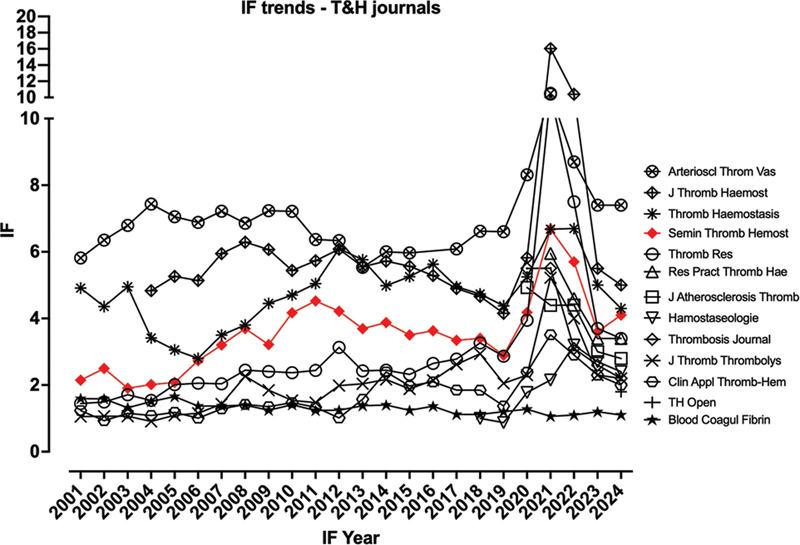
The 2024 Impact Factor was 4.1, which marked an unexpected increase over the 2023 IF, which was 3.6; the increase was unexpected, as all other Thrombosis and Hemostasis-related journals saw a decrease in their Impact Factor ([Fig. 1]).[9]
-
The 2023 Impact Factor was 3.6, which marked an anticipated decrease over the 2022 IF, which was 5.7; the decrease was anticipated and due to the decreased impact of COVID-19 (coronavirus disease 2019) papers and changes in the way in which the Impact Factor was calculated.[9]
-
The 2022 Impact Factor of 5.7 also marked an anticipated decrease over the 2021 IF, which was 6.938; the decrease was anticipated for the same reasons as noted above.[9]
-
The 2021 Impact Factor for STH (6.938) marked a substantive increase over the 2020 Impact Factor, which was 4.180, and the 2019 Impact Factor, which was 2.892.
-
The 2021 Impact Factor of 6.398 also represents the highest Impact Factor ever achieved by STH, and this was largely due to some highly cited papers related to COVID-19.
-
The previous highest Impact Factor (4.524) was over 10 years ago in 2011.
-
In general, most thrombosis and hemostasis focused journals showed an increase in Impact Factor from 2020 to 2021, largely on the back of several highly cited COVID-19 related papers, and then subsequent falls in 2022 to 2024 due to “waning interest” in COVID-19 (or fewer COVID-19 manuscripts and citations), as well as due to changes in the way the Impact Factor was calculated.[9]
It is also worthwhile mentioning the placement of STH in the journal categories of “Hematology” and “Peripheral Vascular Disease,” which has improved over recent years ([Fig. 2]). STH was ranked 21/98 in the Hematology category of the Science Citation Index Expanded (SCIE) in 2024, compared with 25/97 in 2023, 20/79 in 2022, 21/78 in 2021, 28/76 in 2020, and 36/76 in 2019. Similarly, STH was ranked 20/98 in the Peripheral Vascular Disease category of the SCIE in 2024, compared with 22/96 in 2023, 15/67 in 2022, 14/67 in 2021, 21/65 in 2020, and 26/65 in 2019. Importantly, STH remains in Quartile 1 of the Peripheral Vascular Disease category, and has also moved back into the Quartile 1 category for Hematology.

I will also share that STH has published close to 1,000 pages in several years over the past decade, with the celebratory (50-year anniversary) year of 2024 marking the highest number of printed pages in all time, publishing well in excess of 1,000 pages ([Fig. 3]). This landmark metric was largely due to STH republishing of historical papers, and several accompanying Commentaries, to help celebrate 50 years of STH publishing. The journal only exceeded 1,000 pages in one other year, 2020.

The number of papers published by STH has remained fairly constant over the past decade ([Fig. 4]). STH publishes approximately 120 manuscripts a year, with the majority being reviews in keeping with the original concept of STH as a “Seminars” journal. However, for reasons explained in previous editorials, STH now also considers the publication of original studies, with these averaging around 10 to 15 per year since 2015. STH also publishes Commentaries on topics related to thrombosis and hemostasis, with two peaks in 2020 (related to COVID-19) and 2024 (related to the 50-year anniversary celebrations), as well as a Preface with each issue, occasional editorials such as this, and Letters to the Editor/Correspondence ([Fig. 4]).

As noted in previous editorials, STH has moved to an online submission system (https://mc.manuscriptcentral.com/sth). This occurred in late in 2024, and has led to an increase in unsolicited manuscript submissions, in particular Original Studies and Reviews ([Fig. 5]). Although the early yearly data pre-ScholarOne (2015–late 2024) only captured unsolicited manuscripts, the post-ScholarOne data (late 2024 and all of 2025 [data to end of October only]) includes both solicited (primarily reviews) and unsolicited manuscripts (both Original Studies and Reviews). Nevertheless, a large increase in submissions has occurred in 2025. This has placed extra pressure on the editorial board for handling and reviewing papers for STH.

Nevertheless, the acceptance rates for unsolicited manuscripts have not changed appreciably over the past decade ([Fig. 6]). Current acceptance rates for original studies are around 20%, and for reviews and Letters/Correspondence around 50 to 60%. Considered the reverse way, around 80% of original studies submitted to STH are rejected, and around 40 to 50% of unsolicited reviews and Letters/Correspondence are also rejected.

STH Content in Progress and Updated Publication Policy
As I now also always do for the Welcome Editorial,[10] I confirm that STH, as always, will continue to develop plans for the future content of this journal, and we are confident that our journal will be able to continue to bring its readers the high-quality journal that is expected of us. Currently confirmed topics for issues that we plan to publish over the next 12 or so months are listed in [Table 1]. Naturally, we recognize the need to retain some flexibility in our plans and to potentially add additional material of current interest and controversy as the need arises.
Given the increased workload in regard to unsolicited manuscripts, there has also been a change initiated in the issue “series” published by STH, as well as some redistribution of workload. In the past, the main two ongoing series compilations were those represented by (1) the “Recent Advances in Thrombosis and Hemostasis” series, as Guest edited by Prof Sam Schulman, and comprising primarily thrombosis related manuscripts, and (2) the “Editorial Compilation” series, Guest Edited by myself, and Profs Leonardo Pasalic, Bingwen Eugene Fan, and Giuseppe Lippi, and comprising manuscripts primarily related to bleeding or laboratory diagnostics. Most of the laboratory diagnostics manuscripts are now published in a third ongoing series compilation, currently Guest Edited by Kristi Smock and Karen Moffat. Several other ongoing series compilation themes have been established to help manage the increased workload, namely covering platelets, sex-related thrombosis/hemostasis issues, cancer, and antithrombotic/anticoagulant therapy, as Guest Edited by the other senior editors of STH ([Table 1]).
Thus, manuscripts that seem related to one of the above themes will now be in general handled by the Senior Editors of STH as per the particular identified theme. The Senior Editors will, in general, handle reviewer requests and decisions on the submitted manuscripts based on the review outcome, and then make recommendations to the Editor in Chief regarding the outcome of review (e.g., reject, minor revision, major revision, accept). These Senior Editors are also able to solicit manuscripts for publication in their ongoing issue series; however, these solicited manuscripts are still subject to peer review, and are only accepted for publication in STH if they pass the review process.
Similarly, several other themed issues of STH have also been approved for progression ([Table 1]), and manuscripts that seem related to one of these themes will, in general, be handled by the issue's Guest Editor(s) as per the particular theme identified.
STH Production Team
I also take this opportunity to once again thank the journal production team at Thieme Medical Publishers for their high production standards and for facilitating both the print and online issues of the journal, and in particular, Mansi Agarwal, the current Production Editor for STH, and her production team. I also thank the ScholarOne team and the Thieme Journal development and publisher teams for their contributions, and note that STH would not be here if it weren't for the great teams involved in its production.
In conclusion, I look forward to another interesting year of reading in 2026, being the second year in the second 50 year-round of STH publishing!
Conflict of Interest
None declared.
-
References
- 1 The first issue of STH. Accessed October 28, 2025 at: https://www.thieme-connect.com/products/ejournals/issue/10.1055/s-012-55744
- 2 Favaloro EJ. Celebrating 50 years of seminars in thrombosis and hemostasis-part I. Semin Thromb Hemost 2022; 48 (08) 871-874
- 3 Favaloro EJ. Celebrating 50 years of seminars in thrombosis and hemostasis-part II. Semin Thromb Hemost 2023; 49 (03) 212-216
- 4 Favaloro EJ. Celebrating 50 years of seminars in thrombosis and hemostasis-part III. Semin Thromb Hemost 2024; 50 (01) 4-7
- 5 Favaloro EJ. Celebrating 50 years of seminars in thrombosis and hemostasis-part IV. Semin Thromb Hemost 2024; 50 (05) 677-681
- 6 Favaloro EJ. 2023 Eberhard F. Mammen Award announcements: part I-most popular articles. Semin Thromb Hemost 2023; 49 (05) 417-426
- 7 Favaloro EJ. 2024 Eberhard F. Mammen Award announcements: part I-most popular articles. Semin Thromb Hemost 2024; 50 (07) 919-932
- 8 Favaloro EJ. 2025 Eberhard F. Mammen Award announcements: part I-most popular articles. Semin Thromb Hemost 2025; 51 (04) 366-380
- 9 Favaloro EJ. Seminars in thrombosis and hemostasis: 2024 impact factor, most highly cited papers, and other journal metrics. Semin Thromb Hemost 2025; 51 (08) 844-854
- 10 Favaloro EJ. Welcome to seminars in thrombosis and hemostasis 2024: 50 years of publishing. Semin Thromb Hemost 2024; 50 (01) 1-3
Address for correspondence
Publication History
Received: 10 November 2025
Accepted: 10 November 2025
Article published online:
25 November 2025
© 2026. Thieme. All rights reserved.
Thieme Medical Publishers, Inc.
333 Seventh Avenue, 18th Floor, New York, NY 10001, USA
-
References
- 1 The first issue of STH. Accessed October 28, 2025 at: https://www.thieme-connect.com/products/ejournals/issue/10.1055/s-012-55744
- 2 Favaloro EJ. Celebrating 50 years of seminars in thrombosis and hemostasis-part I. Semin Thromb Hemost 2022; 48 (08) 871-874
- 3 Favaloro EJ. Celebrating 50 years of seminars in thrombosis and hemostasis-part II. Semin Thromb Hemost 2023; 49 (03) 212-216
- 4 Favaloro EJ. Celebrating 50 years of seminars in thrombosis and hemostasis-part III. Semin Thromb Hemost 2024; 50 (01) 4-7
- 5 Favaloro EJ. Celebrating 50 years of seminars in thrombosis and hemostasis-part IV. Semin Thromb Hemost 2024; 50 (05) 677-681
- 6 Favaloro EJ. 2023 Eberhard F. Mammen Award announcements: part I-most popular articles. Semin Thromb Hemost 2023; 49 (05) 417-426
- 7 Favaloro EJ. 2024 Eberhard F. Mammen Award announcements: part I-most popular articles. Semin Thromb Hemost 2024; 50 (07) 919-932
- 8 Favaloro EJ. 2025 Eberhard F. Mammen Award announcements: part I-most popular articles. Semin Thromb Hemost 2025; 51 (04) 366-380
- 9 Favaloro EJ. Seminars in thrombosis and hemostasis: 2024 impact factor, most highly cited papers, and other journal metrics. Semin Thromb Hemost 2025; 51 (08) 844-854
- 10 Favaloro EJ. Welcome to seminars in thrombosis and hemostasis 2024: 50 years of publishing. Semin Thromb Hemost 2024; 50 (01) 1-3